
Top QA Software Testing Services – Not “ChatGPT” Approved
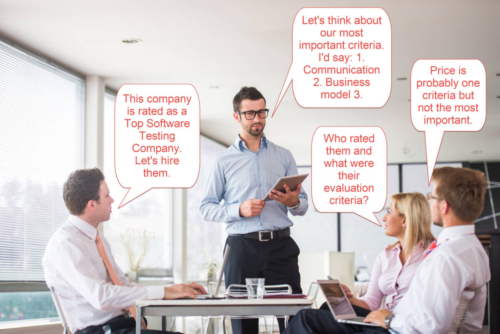
What criteria should be used when evaluating a QA Software Testing Services Firm?
The purpose of this blog is to assist you in sorting through all the information you find out there regarding QA software testing companies. There seems to be an epidemic, or even a pandemic in terms of the sickness, havoc, and injury caused by biased, inaccurate, and incorrect information. Whenever you read a news article, it’s difficult to discern what is real and what is opinion. Unfortunately, it seems that we’ve lost the ability to cross-reference information, ask questions, and think beyond our initial reactions and thoughts. Additionally, we fail to see the motives behind the presentation of the information and see the cherry-picking of facts and data to ‘prove’ whatever the author wants us to believe.
Unfortunately, this happens in the world of QA software testing as well. There have been many blogs about and ratings of QA software testing services companies pertaining to the ‘top’ companies. When I see these directories and how they rate them, I chuckle yet also become a little somber and sad that many who are reading these articles and directories actually believe them. What I realize is that most people don’t really dig deep to understand how the ratings were done, what criteria were used, or how the software testing services company got its name on the list of top QA software testing companies.
Most of them don’t communicate well, just follow orders, and bill by the hour, and sometimes you don’t know what they did with all the hours they billed. Let’s discuss each of these.
Communication
We recently completed a 2-week assessment of a potential client’s software examining their mobile test automation scripts and how we could improve them. They noted how good we were at communication, especially in asking questions. Questions that lead them (and us) to a greater understanding of their goals and objectives as well as how mobile test automation would fit into their overall QA strategy. We always say that correct answers are great, but good questions are even better. Often, figuring out the right question and the right problem to solve is much harder and more valuable. The last thing you want is someone who says yes to everything you ask for but then doesn’t deliver.
Business Model (Bill by the Hour)
Most QA software testing companies will bill you by the hour and for every hour. You may get an invoice at the end of the month listing that John Jones worked 198 hours for the month and you scratch your head thinking “What did he do? What did he get done?” At XBOSoft, we do what it takes to get the job done and sometimes that means we have to work overtime or on weekends. Our flat rate means you don’t pay for overtime so you know exactly what your bill will be at the end of the month. Clients may think ‘Wow, I can make them work 200 hours a month and get free time’. However, with our partnership mentality, our clients know that no one can maintain that level of overtime in the long term. They also know that over time, if abused, leads to turnover. When our employees walk out the door, knowledge of the client’s software also walks out the door. That’s good for no one.
Follow Orders and Contribute Knowledge and Expertise
Following the mantra of Joel Sposky, we believe in “Smart and Get Things Done”. What this means for our clients is that sometimes we may not agree with tasks that we are assigned as we may think it’s not the smartest thing to do or prioritize based on our client’s software quality objectives. Our clients appreciate that we are always thinking in addition to getting things done. We all know that just ‘getting things done’ doesn’t matter when they don’t help you reach your goal. Especially when it comes to QA Software Testing activities, you don’t just want to get stuff done, you want to do the right thing! Does it matter how many bugs you find if your overall software quality doesn’t improve?
So how should you evaluate a QA software testing services company? Look at some directories you found online and go with whoever is at the top of the list? Find the cheapest? Find one that uses the latest ChatGPT, Artificial intelligence, or Machine Learning tools? If you want long-term success as we’ve had with so many of our clients, and to partner and work with hard-working folks that are as honest as the day is long (that’s what my Dad used to say), you know where to go. [email protected]

Leave A Comment