Best Practices for Defect Management
Published: March 29, 2022
Updated: September 14, 2025
When Defects Surface
Defects often appear in ways that are as inconvenient as they are costly. Some are caught in the test environment before release, others only emerge once a product is in the hands of customers. In rare cases, they make headlines—like the time a PayPal customer logged in to see a $92 quadrillion balance caused by a programming error. While most bugs don’t carry that level of drama, the consequences of a missed defect can still include financial loss, reputational damage, and delays that ripple across development schedules.
Teams know that no software is perfect. Complexity, shifting requirements, and tight timelines make flaws inevitable. What distinguishes resilient organizations is not the absence of defects, but how they are identified, tracked, and resolved. Defect management provides the structure for doing this well. It transforms a chaotic flow of bug reports into an organized process that minimizes risk, reduces cost, and builds confidence with every release.
The Defect Lifecycle
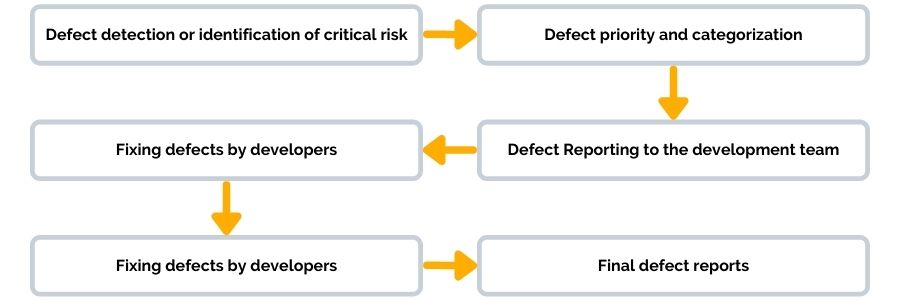
Defect management begins the moment an issue is discovered and doesn’t end until the fix is verified and the defect is closed. This lifecycle creates a common language for QA, developers, and stakeholders, making the handling of defects predictable rather than ad hoc.
Discovery and Logging
A defect first becomes visible when someone notices unexpected behavior. This might happen during structured test execution, exploratory testing, or through a user report in production. However, a defect is only useful to the team once it has been logged clearly. Vague notes like “login broken” leave developers with little to act on. A good report specifies the action taken, the environment, the data used, and what happened instead of the expected result. Supporting evidence—logs, screenshots, or video—further reduces ambiguity.
Triage and Classification
Not every defect deserves the same response. Once logged, defects are triaged to establish severity (the impact on the system) and priority (how quickly it must be fixed). A crash that blocks user authentication is urgent and severe, while a misaligned button may be minor and low priority. Teams that agree on definitions avoid wasting energy debating classifications. Instead, they focus on aligning defect handling with business risk.
Resolution and Verification
Once assigned, a defect moves into active work by developers. Fixes are committed, merged, and deployed into the test environment. QA then verifies whether the issue has been resolved and checks for unintended side effects. Only when the resolution has been confirmed can the defect be closed. This final step ensures that fixes don’t just exist in code, but actually restore expected functionality in the product.
Reporting with Clarity
Among all stages of the defect lifecycle, reporting has an outsized influence on efficiency. A well-written defect report accelerates diagnosis and shortens the path to resolution. A poor one, by contrast, leads to confusion, wasted cycles, and sometimes the dismissal of real issues as “not reproducible.”
Effective reports answer three questions:
- What happened? A concise description of the defect.
- When did it happen? The context or conditions that triggered it.
- Where did it happen? The environment, browser, device, or OS involved.
For example: “When using Chrome 119 on macOS Sonoma, selecting ‘Load File’ on the home page produces an ‘Unknown error’ instead of opening the dialog box.” That single sentence provides enough information for developers to attempt reproduction without further clarification.
Reports also benefit from categorization. Teams that tag issues as UI, functional, integration, or architectural gain visibility into patterns. A spike in database issues may suggest deeper design flaws. Clusters of cosmetic defects may reveal gaps in UI standards. Over time, these patterns help leaders target root causes instead of treating every issue as an isolated problem.
Prioritization and Severity
Even with clear reporting, defect management breaks down if teams don’t distinguish between what must be fixed immediately and what can wait. That is why prioritization and severity are tracked separately.
- Severity measures the technical impact of a defect: from system crashes and data loss at the top, to minor formatting issues at the bottom.
- Priority reflects urgency: how quickly the issue needs to be resolved based on business and user impact.
This distinction prevents critical but obscure issues from being buried, and ensures minor but highly visible defects are not left unaddressed. For example, an application crash when entering more than 1,500 characters in a name field may be severe but low priority if normal inputs are capped at 60 characters. By contrast, an incorrectly displayed logo may be low severity but high priority due to its effect on brand perception.
Teams that document and apply these classifications consistently can allocate resources intelligently, avoid bottlenecks, and reduce the risk of critical defects escaping into production.
| Priority Level | Description |
|---|---|
| P1-Urgent | Defects are urgent and need to be fixed immediately. |
| P2-High | Defects must be resolved in this release. |
| P3-Medium | Defects should be fixed, but do not hold shipment for them. |
| P4-Low | Defects are present but can be deferred to the next release. |
| Severity Level | Description |
|---|---|
| Blocker | System crash, mission functionality |
| Critical | Data loss, security issues |
| Major | Website hangs, script errors |
| Normal | UI issues, small functional issues |
| Minor | Cosmetic Problems |
Reproducibility as the Foundation
No matter how well a defect is described, it is of limited use unless it can be reproduced. Developers need a repeatable sequence of steps to see the problem for themselves and verify the fix later. Ambiguity at this stage often leads to “works on my machine” disputes that slow down delivery.
A reproducible defect report documents the sequence of actions clearly and concisely. Each step should be simple, starting with the initial conditions and moving through the interactions that trigger the issue. Using verbs at the beginning of steps (“Select File,” “Click Save,” “Enter value”) makes reports easier to follow. Supporting artifacts—such as log files, screenshots, or video captures—provide added assurance that the defect is real and not a misinterpretation.
When reproducibility is prioritized, the path from logging to resolution becomes far smoother. Testers save time chasing unclear reports, developers avoid rework, and the business benefits from faster turnaround.
Actual Versus Expected Results
Every defect carries two stories: what actually happened and what should have happened. Capturing both in a structured way eliminates guesswork. A simple comparison highlights the gap between behavior and requirement.
- Actual Result: An “Unknown error” message appears when the user attempts to load a file.
- Expected Result: The Load File dialog box opens, allowing the user to select a document.
This side-by-side view grounds the defect in business expectations. It shifts the focus from subjective opinions (“the page looks odd”) to objective evaluation against requirements. In regulated industries, this clarity also supports compliance, demonstrating that test results are measured against documented specifications.
Supplementing with Context
Defect management benefits when teams go beyond the basics. Adding relevant context, while avoiding unnecessary detail, can save hours of back-and-forth.
Additional information might include:
- The environments where the defect was and was not observed.
- The type of test data used and whether similar inputs produced the same outcome.
- Links to related test cases, requirements, or prior defect reports.
This context helps developers understand whether an issue is isolated or systemic. It also aids testers when verifying the fix, reducing the risk of regressions slipping through.
Strengthening the Process
The strength of defect management lies not only in individual reports but in the overall system. Teams that treat defect management as an integrated part of the development lifecycle, rather than a bureaucratic afterthought, gain resilience.
Well-defined processes reduce defect leakage, the industry term for bugs that escape into production. They also provide valuable data for continuous improvement. By analyzing defect trends—such as recurring issues in a specific module or frequent integration failures—teams can target systemic weaknesses and invest in preventative measures.
Beyond metrics, strong defect management reinforces trust. Product owners gain confidence that reported issues are handled systematically. Developers appreciate clear, actionable reports instead of vague complaints. Testers see that their work leads to tangible improvements. Together, these outcomes create a culture where quality is shared, not siloed.
A Closing View
Defects are inevitable, but poor handling is not. By emphasizing clarity, reproducibility, prioritization, and context, organizations can transform defect management from a reactive scramble into a proactive driver of quality. Every clear report not only accelerates resolution but also strengthens the feedback loop that underpins agile development.
In practice, defect management is less about perfection than about discipline. The best teams accept that bugs will appear but build processes that contain, categorize, and resolve them before they cause harm. That discipline keeps releases on track, customers satisfied, and reputations intact.
The XBOSoft Perspective
Defects are not just a technical nuisance; they are a signal of how well teams manage knowledge, communication, and priorities. At XBOSoft, we have seen how disciplined defect management can shorten release cycles, reduce rework, and build trust between development and QA. The process works best when it is treated as a continuous flow of learning, not just an isolated step after testing. With structured reporting and clear prioritization, defects become less of a firefight and more of a feedback loop that strengthens quality over time.
Next Steps
Explore More
See how structured testing services fit into a broader strategy and strengthen long-term quality outcomes.
Explore The Ultimate Guide to Software Testing Services
Shape Testing Around Priorities
Build a defect management process that focuses on what matters most—business risk, user impact, and clear outcomes.
Contact XBOSoft
Gain Practical Tools
Learn proven methods for tracking, categorizing, and resolving defects without slowing delivery.
Download the “Defect Management Best Practices” White Paper
Related Articles and Resources
Looking for more insights on Agile, DevOps, and quality practices? Explore our latest articles for practical tips, proven strategies, and real-world lessons from QA teams around the world.